National Water Agreement Creates Uncertainty for Farmers' Water Rights
Queensland Water Advisory Services Principal, Judy Plath, has raised concerns that the federal government's proposed National Water Agreement could undermine existing water rights for farmers and landholders.
WATER RIGHTS
2/12/20264 min read
States urged to sign National Water Agreement even though users unaware what's in final version
In short:
Australia's biggest water users fear they have been overlooked in the new National Water Agreement.
The federal government has signed the NWA, which will dictate how the nation's water resources will be used.
States and territories are to consider signing the agreement, but the Queensland government says the federal government has not made its case.
Australia's biggest water users say they have been kept in the dark on changes to national water policy as pressure mounts for states to sign up.
The federal government is encouraging states and territories to sign the new National Water Agreement (NWA) which will dictate how the country's water resources are managed.
But irrigators, who raised concerns they were left out of the draft released in 2024, say they have not seen the details of the final agreement.
As water ministers consider their options and others welcome being included for the first time, farmers fear they will not know what it means for them until it is too late.
Sign up and see
The draft NWA was released in 2024 after three rounds of public consultation.
It followed a 2021 review that found the 20-year-old National Water Initiative (NWI) was considered unfit to meet the challenges posed by climate change, and left Aboriginal and Torres Strait Island peoples out of the national conversation on water.
At the time farmers criticised the draft for overlooking agriculture, which accounts for almost 75 per cent of national water consumption, as a key stakeholder.
Chief executive of industry representative body the National Irrigators Council, Zara Lowien, said they do not know if the final agreement addressed the concerns they raised during the consultation process.
"We're assured agriculture is front and centre, but we actually haven't seen the wording," Ms Lowien said.
"I can't say whether the wording is better than the previous version and that is the core frustration we have right now."
A spokesperson for the Department of Climate Change, Energy, the Environment and Water (DCCEEW) said the final agreement will be released publicly once it has been signed by jurisdictions and is in effect, as is standard practice for intergovernmental agreements.
So far, only the federal government has signed it.
In response to questions from the ABC, New South Wales, South Australia and Victoria all indicated they were still considering their options or further consultation.
Queensland's Minister for Water Ann Leahy said the concerns of major users in her state, like farmers and irrigators, were not being heard.
"I haven't found a single stakeholder, nor have I found a single state government, that I've chatted to across Australia, who are interested in signing this current agreement," Ms Leahy said.
"The federal government have not made the case."
Uncharted waters
In Queensland's Wide Bay, one of the state's major food bowls, farmers like soybean and sugarcane grower Judy Plath feared their existing water rights would not be protected.
"It [the draft] barely refers to agriculture, or farmers or irrigators," she said.
"It really brushed over them as a key water user."
Under the existing NWI, state and federal policies set caps on how much water could be extracted from river and groundwater sources, and how water should be shared between households, industry and the environment.
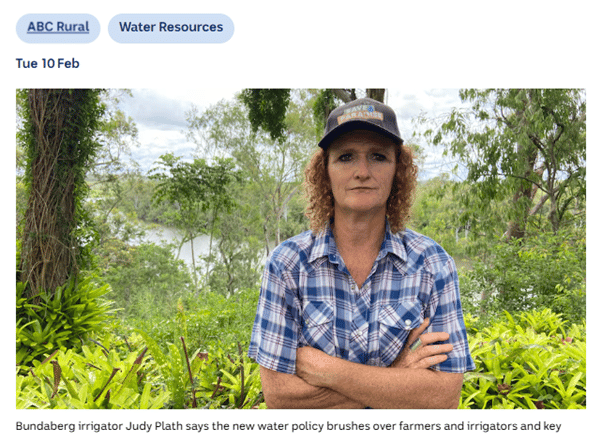
Bundaberg irrigator Judy Plath says current water policy can be modernised without having to sign a new National Water Agreement.
Ms Plath questioned the need for a new agreement.
"There's already appropriate mechanisms through that state-based planning to update water plans according to changing water needs, changing climate conditions," she said.
"There's no reason that the Queensland government cannot modernise their water plans according to new policies without having to sign on the to the new National Water Agreement."
Bree Watson fears funding to replace the region's failed Paradise Dam will be used as a 'political football'.
Farmers in the region, 400 kilometres north of Brisbane, are already anxious about water security, as they wait for the $4.4 billion rebuild of the troubled Paradise Dam, which had its capacity reduced due to structural concerns in 2019.
Bundaberg Fruit and Vegetable Growers chief executive Bree Watson said she feared federal funding for water projects could be conditional on compliance with national water policies.
"It's highly likely any future funding support will be tied to the new water agreement," she said.
Industry groups fear the rebuilding of Paradise Dam near Bundaberg will be tied to support of the new National Water Agreement.
"This region has been through too much heartache over the future of Paradise Dam to endure more political wrangling."
Once a state signs the new agreement it will replace the previous policy framework, but Ms Lowien feared that put a nationally-consistent approach to water management at risk.
"The old agreement still stands for the remaining states that do not sign the new one, and that will give us a two-tier system," she said.
But while farmers worried about future inclusion in the policy, those not represented by the current framework have welcomed the opportunity to participate.
Australian National University senior researcher Virginia Marshall, a Wiradjiri Nyemba woman, said First Nations inclusion was "a long time coming".
"For traditional owners in various areas across the nation it really does provide hope," she said.
"[It provides] the ability to be strongly part of the Australian economy in the areas of resources and water.
"We need to bring in voices that were here for 65,000 years in that water resources space."